Executive Summary
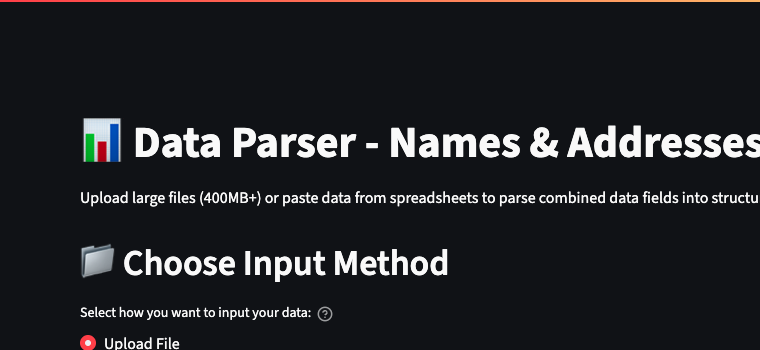
Data Parser is a self-service preparation tool for teams receiving provider, customer, or CRM records in inconsistent spreadsheet formats. It accepts files or pasted data, identifies likely name, address, and phone fields, parses combined values, and produces a normalized CSV.
The MVP proves the core workflow. The productized version should make it safer, more explainable, repeatable, and scalable through mapping review, exceptions, job history, privacy controls, and provider-neutral outputs.
My role: Product strategy, requirements definition, workflow design, trust and privacy framing, and portfolio narrative.
Business Problem
Current situation
- Combined personal names, professional titles, and organization names
- Addresses with inconsistent abbreviations, units, PO boxes, and missing components
- Phone numbers with country codes, punctuation, extensions, and mixed formats
- Source-specific headers such as Account Owner, Contact, Provider, or Mobile
- Different file encodings and separators
- Destination requirements that are stricter than the source data
| Impact | What it creates |
|---|---|
| Operational cost | Staff repeatedly inspect, rewrite, and re-upload files. |
| Workflow delays | CRM and audience activation waits on manual cleanup. |
| Data quality risk | Incorrect parsing and lost leading zeroes reduce matchability. |
| Rework | Format problems surface only after a downstream rejection. |
| Low repeatability | Cleanup logic stays in spreadsheets or individual memory. |
| Privacy exposure | Sensitive records spread across unmanaged temporary files. |
Product Vision
Enable a non-technical operator to turn an unfamiliar CRM or provider file into a validated, explainable dataset mapped to a defined destination schema, without writing code or rebuilding spreadsheet formulas.
Goals and Non-Goals
| Business goal | Why it matters |
|---|---|
| Reduce time from raw file to usable export | Directly measures operational efficiency |
| Improve first-pass data acceptance | Prevents downstream upload failures |
| Make transformations explainable | Builds trust in automated parsing |
| Support repeatable preparation workflows | Reduces dependence on spreadsheet experts |
| Establish a reusable normalization layer | Enables future CRM, marketing, and analytics destinations |
Initial non-goals
- Full CRM synchronization or two-way integration
- External people, address, or identity enrichment
- Guaranteed identity resolution or cross-source deduplication
- Replacing a master data management system
- Automated campaign activation
- Destination hashing or matching without a defined privacy policy
- Supporting every global address convention in the first release
Product Scope
- CSV, TSV, text, and spreadsheet-paste input
- Direct-URL input for non-sensitive demonstration data
- Encoding and separator detection with manual overrides
- Configurable chunk-based processing designed to reduce memory pressure
- Heuristic detection of likely name, address, and phone fields
- Parsing for common names, prefixes, suffixes, organizations, addresses, and units
- Source preview, column information, quality metrics, and configurable rules
- A preset export schema for StackAdapt workflows, with no direct platform integration
- CSV download plus optional history when PostgreSQL is configured and healthy
- Source-to-target mapping review before processing
- Row-level validation and a downloadable exceptions file
- Explicit confidence thresholds and needs-review states
- A summary of inferred, parsed, unchanged, and blank values
- Text-safe postal-code handling that preserves leading zeroes
- Reusable, named rule profiles
- Versioned job history and downloadable audit reports
- File size, type, record-count, and privacy warnings
- A destination-profile framework beginning with StackAdapt
Stakeholders and DACI
| Role | Who | Responsibility |
|---|---|---|
| Driver | Product Manager / Portfolio Owner | Own narrative, requirements, priorities, and delivery |
| Approver | Portfolio Owner | Final scope and portfolio-story sign-off |
| Contributor | Operations or CRM user | Validate workflow and terminology |
| Contributor | Data / engineering reviewer | Validate parsing, scale, security, and maintainability |
| Contributor | Marketing activation reviewer | Validate destination requirements |
| Informed | Portfolio audience / hiring manager | Understand decisions, tradeoffs, and outcomes |
Target Users
CRM or marketing operations specialist
Receives files from multiple sources, works comfortably in spreadsheets, and needs an export mapped to a defined schema without writing code.
Data analyst or implementation specialist
Handles larger files and unfamiliar schemas, requiring repeatable rules, confidence signals, and an audit trail.
Campaign or platform administrator
Consumes the normalized output and cares about exact headers, formats, minimum record counts, and matchability.
User Jobs and Journey
Job stories
- 01When I receive a file with unfamiliar columns, I want the tool to identify likely fields and show confidence so I can correct mappings before processing.
- 02When a source combines titles and names, I want those values separated consistently for downstream CRM and audience workflows.
- 03When addresses use mixed abbreviations and unit formats, I want standardized fields that meet destination requirements.
- 04When I upload a large file, I want visible progress and memory-conscious processing so I do not have to split it manually.
- 05When parsing is uncertain, I want those rows isolated so I can fix exceptions instead of reviewing the entire file.
- 06When I repeat a source workflow, I want a saved rule profile so the result stays consistent.
Target journey
- Select an input method.
- Upload or paste data.
- Confirm encoding, separator, headers, and record count.
- Review the source preview and detected mappings.
- Adjust mappings or select a saved rule and destination profile.
- Process with visible progress feedback.
- Review output, quality metrics, and exceptions.
- Download normalized output and an optional validation report.
- Optionally save a versioned processing job.
Business Requirements
| ID | Requirement | Priority |
|---|---|---|
| BR-001 | Reduce manual spreadsheet cleanup for provider and CRM files. | Must |
| BR-002 | Support low-volume copy/paste and file-based workflows. | Must |
| BR-003 | Process large files without requiring manual splitting. | Must |
| BR-004 | Preserve source data and distinguish derived fields. | Must |
| BR-005 | Show inferred transformations before irreversible export. | Must |
| BR-006 | Identify records that fail required formatting or matching rules. | Must |
| BR-007 | Produce output mapped to at least one defined destination profile. | Must |
| BR-008 | Repeat workflows with consistent parsing rules. | Should |
| BR-009 | Provide a processing summary and exception report. | Should |
| BR-010 | Protect personal data through retention and access controls. | Must |
| BR-011 | Make performance and failure behavior visible. | Should |
| BR-012 | Support new destination profiles without rewriting the parser. | Could |
Success Measures
Validated records mapped to the selected export schema per completed job.
These are proposed launch targets, not observed results. They must be baselined against real usage before becoming commitments.
| Metric | Definition | Initial target |
|---|---|---|
| Time to first usable export | Upload or paste to successful download | Under 5 minutes |
| First-pass completion rate | Jobs finishing without a system error | At least 95% |
| Destination acceptance rate | Exports accepted without manual reformatting | At least 90% |
| Parse coverage | Required nonblank fields successfully derived | At least 95% |
| Exception rate | Rows requiring manual review | Under 10% |
| Repeat workflow rate | Jobs using a saved profile | At least 30% |
| User trust signal | Users reviewing and accepting mappings and output | At least 80% |
| Privacy incidents | Confirmed exposure or unauthorized access | 0 |
Alternatives and Differentiation
| Alternative | Current gap |
|---|---|
| Spreadsheet formulas | Slow, brittle, hard to audit, and difficult to repeat |
| One-off scripts | Powerful but dependent on technical skill and maintenance |
| General data-cleaning tools | Flexible but often too complex for this focused job |
| CRM import wizards | Feedback arrives late and may not explain source issues |
| Manual operations service | Expensive and inconsistent at scale |
The differentiation is not AI alone. It is focused provider and CRM normalization, explainable detection, destination-specific formatting, and a low-friction self-service workflow.
Risks and Mitigations
| Risk | Mitigation |
|---|---|
| Silent identity or address changes | Preserve raw columns, show confidence, and require review below threshold |
| Misclassified source columns | Confirm mappings, use deterministic rules, and retain a safe Other state |
| Lost postal-code zeroes | Read postal fields as text and validate length |
| Unsupported international formats | Declare geographic scope and isolate unsupported rows |
| Large-file memory exhaustion | Use streaming, configurable chunks, progress, and resource limits |
| Sensitive data in files or logs | Define retention, secure deletion, access controls, and no raw-row logging |
| Destination specification changes | Version destination profiles and maintain contract tests |
| Over-trust in ML language | Expose confidence and describe the system as heuristic or ML-assisted |
| Ambiguous appended history | Use job IDs, source metadata, scoped access, and explicit retention |
Privacy, Security, and Compliance
The product processes names, addresses, phone numbers, email addresses, and provider identifiers. Privacy is a product requirement—not an implementation afterthought.
- Define controller and processor responsibilities before production use.
- Collect only fields required for the selected workflow.
- Display a clear data-processing notice.
- Never log raw rows, full sensitive URLs, credentials, or personal data.
- Use encrypted transport and encrypted retained storage.
- Set a default retention period and provide deletion controls.
- Restrict history to authorized users and separate tenants in multi-user deployments.
- Audit profile versions and outcomes without unnecessarily retaining raw records.
- Validate public download URLs and prefer allowlisted or signed upload flows.
- Obtain legal review for applicable privacy, advertising, and processing obligations.
Delivery Roadmap
Make the MVP trustworthy
- Mapping review and confidence thresholds
- Required-field and destination validation
- Exception rows with reason codes
- Raw-value and postal-code preservation
- Transparent heuristic or ML-assisted language
- Regression fixtures for names, addresses, encodings, and outputs
Make workflows repeatable
- Named and versioned parsing profiles
- Job history with source, rule, destination, and outcome metadata
- Validation and exception reports
- Safer large-file ingestion and explicit limits
- Role-based access and retention controls
Build a normalization platform
- Multiple destination profiles
- API and batch endpoints
- Human review queues
- Deduplication and record lineage
- International address support
- Approved CRM and cloud-storage integrations
Prioritization Snapshot
Prioritization is qualitative because the MVP has no production usage analytics. RICE should be recalculated after the first instrumented pilot.
| Initiative | Impact | Confidence | Effort | Recommendation |
|---|---|---|---|---|
| Mapping review and confidence thresholds | High | High | M | Now |
| Destination validation and exception export | High | High | M | Now |
| Preserve raw values and postal-code text | High | High | S | Now |
| Saved rule profiles | Medium | High | M | Next |
| Job history and audit metadata | Medium | High | L | Next |
| Additional destination profiles | Medium | Medium | L | Later |
| External enrichment | Medium | Low | XL | Validate later |
What I Would Validate Next
- Is the first production geography U.S.-only?
- Is StackAdapt the primary destination or the first example of a broader framework?
- What is the minimum identity combination for each destination?
- Should users edit individual rows in-product or only download exceptions?
- What retention period is acceptable?
- Will the product support authenticated multi-user access?
- Is PostgreSQL history for reuse, audit, or demonstration?
- What maximum file size and processing time should be supported?
- What accuracy threshold is acceptable for each parsed field?
- Which downstream system confirms whether an export was accepted?